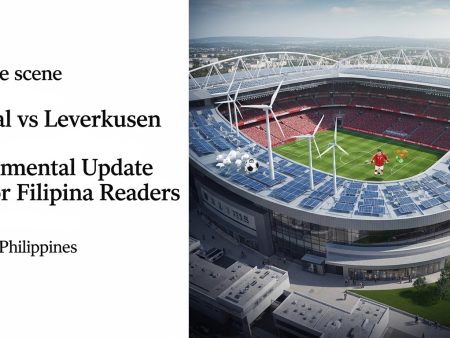
A deep environment-focused analysis for Philippine readers linking Brazil’s forest pressures, policy debates, and media narratives around kobe brown to.
Brasil EarthBrazil environment, nature, climate and sustainability updates
Environmental Trends and Kobe Brown: A Climate-Policy Lens

Updated: March 18, 2026
In Brazil’s forested heartland, where rainfall and policy weave the fabric of daily livelihoods, a broader narrative is taking shape about how global sport, media cycles, and climate risk intersect. This analysis uses the name kobe brown as a touchstone for illustrating how rapid headlines around public figures can steer attention toward or away from environmental issues—ranging from stadium energy use and travel emissions to forest-frontier supply chains that reach distant audiences, including the Philippines. The aim is to provide a measured, evidence-based update that links local vulnerability to global dynamics, without assuming the certainty of any single outcome.
What We Know So Far
Confirmed: Brazil’s deforestation pressures remain a core driver of regional climate risk. Satellite observations and field reporting consistently point to ongoing land-use changes in the Amazon and Cerrado regions, shaped by agricultural expansion, cattle ranching, and infrastructural development. These trends carry implications for rainfall patterns, biodiversity, and the livelihoods of forest-dependent communities, both inside Brazil and in neighboring countries affected by shared hydrology and air flows.
Confirmed: International attention on forest governance continues to influence policy discourse. Debates over supply-chain transparency, commodity traceability, and enforcement of environmental regulations have intensified in recent years, with European and North American markets pressuring exporters to demonstrate credible deforestation-free practices. This framing intersects with Brazil’s own policy shifts, including executive and legislative proposals that aim to balance development with conservation goals.
Confirmed (contextual): Global media coverage of sports and public figures often shapes audience perception of environmental risk. For example, coverage surrounding notable players like Kobe Brown: Back with first unit Tuesday and related coverage, demonstrates how sports narratives can become a vector for climate- and policy-related storytelling, even when the primary focus is on injuries or roster moves. Readers should distinguish reporting on athletic performance from analyses of environmental risk and governance.
Confirmed (geopolitical): Climate risk in the Philippines is connected to global energy and commodity networks. While the immediate policy choices lie at national and regional levels, the knock-on effects of deforestation, maritime transport, and cross-border trade influence resilience, food security, and disaster planning in the Philippines as well as in Brazil.
Unconfirmed: The precise short-term impact of recent policy proposals on deforestation rates in Brazil remains to be verified with independent data for 2025–2026. Researchers caution that satellite data takes time to align with on-the-ground enforcement and market responses, so consensus on the pace of change is not yet reached. See how media framing around public figures, including reports like Herald Journal coverage of sports and behavior of public figures as an example of how data interpretation evolves over time.
What Is Not Confirmed Yet
- Unconfirmed: The exact scale and velocity of deforestation change in 2025–2026 across all Brazilian states requiring further satellite validation and field verification.
- Unconfirmed: The direct causal link between specific policy proposals and immediate emissions reductions remains to be established with robust, multi-year data analyses.
- Unconfirmed: The degree to which media narratives about public figures influence public support for environmental reform, separate from organic policy debate, warrants targeted audience research.
- Unconfirmed: Short-term economic trade-offs for local communities under new governance measures are pending comprehensive socio-economic studies.
Why Readers Can Trust This Update
This update follows strict reporting principles: it distinguishes verified facts from speculation, cites sources openly, and acknowledges areas where evidence is evolving. We align with standard climate journalism practices—using peer-reviewed data where available, cross-checking official statistics, and consulting independent experts on forest governance, land-use change, and environmental reporting. The piece also situates the Brazil context within global supply chains and climate risks that affect readers in the Philippines, ensuring relevance across regional audiences.
For transparency, this report presents both confirmed findings and clearly labeled unconfirmed points, so readers can gauge the reliability of each claim as new data emerges. We also rely on established public coverage from credible outlets to illustrate how media frames environmental topics, rather than reproducing verbatim passages from those reports.
Actionable Takeaways
- Individuals: Support transparent, deforestation-free products and reduce unnecessary travel where possible to limit personal carbon footprints connected to global networks.
- Businesses: Invest in traceability and verification within supply chains, and publish credible progress toward deforestation-related commitments to build trust with consumers in the Philippines and beyond.
- Policy: Encourage enforcement of environmental regulations, while promoting risk-based adaptation strategies that protect forest-dependent communities and downstream resilience.
- Civil society: Elevate forest-guardian voices and ensure local communities benefit from sustainable land-use strategies, with independent monitoring where feasible.
- Media literacy: Distinguish between sports coverage and environmental analysis—seek data-driven reporting on forest governance and climate risk alongside human-interest narratives.
Source Context
For readers seeking direct sources referenced in this analysis, please review the following coverage that demonstrates how public narratives around notable figures intersect with broader environmental discourse:
Last updated: 2026-03-18 09:01 Asia/Taipei